
Every great training plan starts with an honest picture of where a player stands right now. Not where they were last season. Not where a parent thinks they are. Where they actually are today, in measurable, objective terms. That picture is what a skills evaluation produces, and it’s where every athlete’s journey at Lone Star Diamond Academy begins.
For Dallas-area families considering LSDA for the first time, the evaluation process can feel like an unknown. What gets measured? How long does it take? What happens with the results? This post answers all of that so you can walk in prepared and walk out with a real plan.
Why a Skills Evaluation Matters Before Training Begins
Starting a training program without an evaluation is like driving somewhere without knowing your starting point. You might eventually get where you’re going, but you’ll waste a lot of time headed in the wrong direction first.
A skills evaluation removes that guesswork. It tells a coach exactly what a player can do right now, where the gaps are, and which areas will produce the most improvement with focused attention. Without that baseline, training is built on assumptions. A player gets a hitting lesson because that’s what they asked for, not necessarily because hitting is actually the biggest limiter in their development. An evaluation sorts that out before a single rep gets taken.
The baseline also matters for tracking progress over time. A player who starts with a 72 mph exit velocity and works up to 81 mph over four months has a documented record of real development. That’s a different conversation than telling a parent their kid is improving and hoping they believe it. Data-driven baseball development in Dallas, TX starts with a number to beat. The evaluation sets that number.
For players who aren’t sure whether they need hitting instruction, pitching development, strength work, speed training, or some combination, the evaluation answers that too. Coaches at LSDA look at the full athletic picture and help families understand where to invest their time and resources for the best return.
Before the Evaluation: What to Know Going In
Preparation for a skills evaluation at LSDA is straightforward. Players should bring their glove, cleats, batting helmet, and their own bat if they have one. Wearing athletic clothes they can move in freely is all that’s needed beyond that. There’s no need to arrive warmed up to peak performance level. The evaluation is a baseline, not an audition.
LSDA works with athletes across a wide range of levels. Youth players, middle schoolers, high school athletes, college prospects, and even professional-level players have all come through the facility. The evaluation process scales to the athlete. A 10-year-old and a 17-year-old preparing for college showcases are assessed differently, with age-appropriate standards and expectations guiding what coaches look for at each level.
The evaluation is conducted by LSDA’s coaching staff, which brings collegiate and professional playing experience across hitting, pitching, and athletic development. Cameron Dobbs, who played at Oklahoma State and coached at the collegiate level, leads the program. Hunter Markwardt, a former Philadelphia Phillies draft pick, and Chris Muller, drafted by the Tampa Bay Rays in 2017, are among the coaches who may be involved depending on what areas get assessed. Players aren’t being evaluated by someone who only coaches. They’re being evaluated by people who have played the game at a high level and know what the next level actually looks like.
What Happens During the Evaluation
The evaluation covers the areas of the game that matter most for a player’s development path. Not every section applies to every athlete. A player who only pitches gets a different evaluation than one who plays a middle infield position and hits in the middle of a lineup. The process is shaped around the individual from the start.
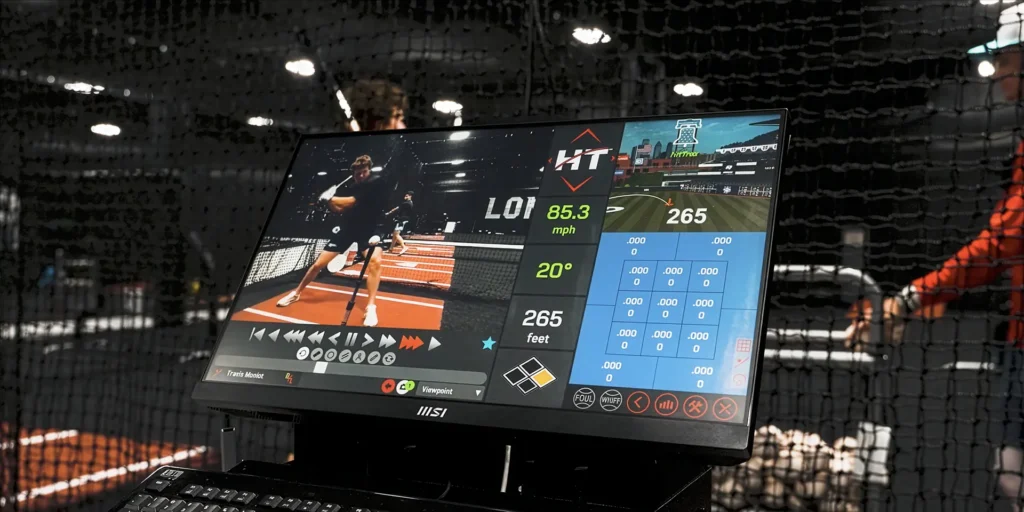
For hitters, the evaluation looks at swing mechanics, bat speed, and contact quality. HitTrax baseball training captures exit velocity and launch angle on live swings, giving coaches objective data on how hard a player is hitting the ball and at what angle it leaves the bat. Video review runs alongside the numbers so coaches can study the full kinetic sequence of the swing. A player learns not just what their exit velocity is but why it is what it is and what mechanical factors are driving it.
For pitchers, the evaluation covers velocity, command, and pitch mechanics. Rapsodo baseball training measures spin rate, spin axis, release point, and pitch movement on every pitch thrown. A pitcher walks away with a real profile of their arsenal, not a single radar gun reading and a coach’s general impression. Command gets assessed through location and repeatability across a full set of pitches. Mechanics are studied through both data and video so coaches can connect what a pitcher feels to what the ball is actually doing.
Fielding and defensive assessment looks at footwork, reaction time, body positioning, and throwing mechanics. Both arm strength and accuracy get evaluated separately because they don’t always go together, and both matter depending on what position a player plays. For athletes where speed and athleticism are a development priority, Casey Mayes evaluates lateral quickness, first-step reaction, and sprint mechanics.
The evaluation also gives coaches a window into how a player competes. Coachability shows up quickly. Does the player listen when given a cue and try to apply it? Do they stay composed when a drill doesn’t go well? Do they compete hard even when the setting is unfamiliar? Those things don’t show up in exit velocity data, but they shape the development ceiling just as much as any physical tool. LSDA coaches pay attention to both.
After the Evaluation: Turning Results Into a Plan
The evaluation doesn’t end when the last rep is taken. What happens next is where the real value gets delivered.
Coaches sit down with the player and family to walk through the results. That conversation covers what the data showed, what it means in plain terms, and what a development plan looks like based on those findings. Parents leave with a clear picture of where their player stands and a specific recommendation for what kind of instruction and how much of it makes sense given their goals and schedule.
From there, LSDA’s membership options give families the flexibility to choose a structure that fits. The Bronze membership covers group training and cage access for players who want an entry point into the program. The Silver membership provides a more structured schedule with fewer sessions per week and focused, high-impact training. The Gold membership is the most all-inclusive option, built for athletes fully committed to elite development. A la carte sessions and lesson packages are also available for players whose schedules or goals call for something more flexible.
Progress gets tracked from evaluation forward. Every session adds data to a player’s record at LSDA, and coaches revisit the development plan as numbers change. A player who hits their first benchmark moves to the next one. A player who plateaus in a specific area gets a plan adjustment. The evaluation isn’t a one-time event. It’s the starting point for an ongoing conversation between the player, the coaches, and the numbers.
What Makes LSDA’s Evaluation Different
A lot of Dallas facilities offer some version of a tryout or assessment. What separates LSDA’s evaluation process comes down to three things.
First, it’s genuinely individualized. The evaluation isn’t a fixed checklist run the same way for every player who walks through the door. It shapes itself around the athlete’s position, age, goals, and what the coaches observe in the first few minutes. A 13-year-old shortstop and a 16-year-old left-handed pitcher are two completely different evaluations.
Second, it blends data with real coaching experience. The Rapsodo and HitTrax numbers are precise and objective. But what they mean for a specific player’s development path takes a coach who has played the game at a high level to interpret correctly. At LSDA, those two things always work together. Data without experienced coaching is just numbers. Experienced coaching without data is guesswork. The evaluation delivers both.
Third, the evaluation looks beyond physical tools. Character, coachability, and mental approach are part of what LSDA coaches assess from the first session. The goal at LSDA has always been to build complete athletes, not just players with impressive numbers. A youth baseball player who shows up with average tools but a strong work ethic and genuine coachability is a different development project than one with elite physical gifts and no interest in being coached. Both deserve a real plan. The evaluation helps coaches understand which kind of athlete they’re working with.
Schedule Your Skills Evaluation Today
Knowing where you stand is the first step toward getting where you want to go. A skills evaluation at Lone Star Diamond Academy gives players and families exactly that: an honest, data-backed starting point and a clear path forward built around the individual athlete.
For DFW baseball families ready to stop guessing and start building, reaching out to schedule an evaluation is the right first move. Contact us or explore our membership options to get started. The numbers are waiting.