
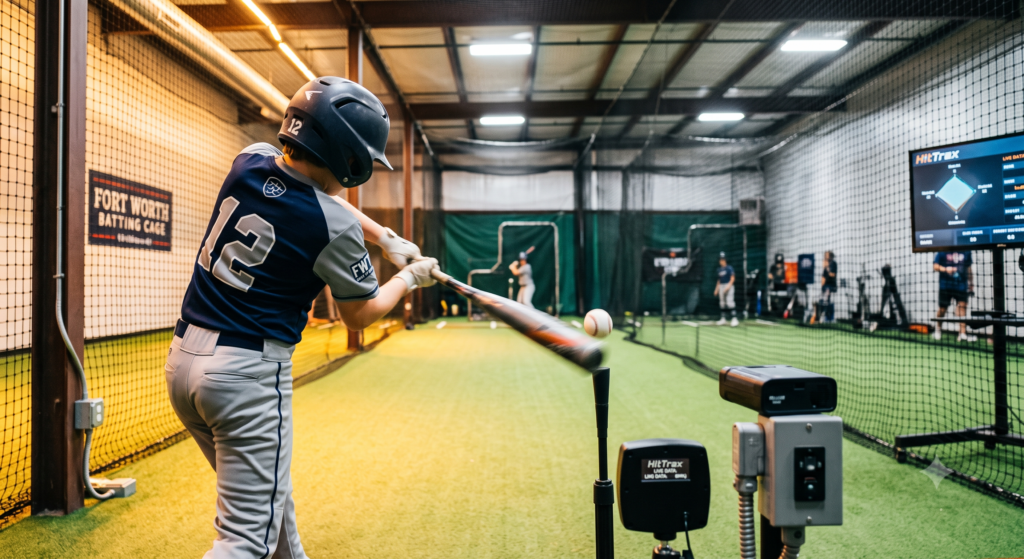
Every hitter wants to hit the ball harder. More power, more line drives, more damage when they make contact. The cleanest path to all of that is bat speed. Not a longer swing. Not a stronger grip. Bat speed. How fast the barrel moves through the zone at the moment of contact is what separates soft grounders from hard-hit balls that find gaps.
The good news for Dallas-area players is that bat speed is trainable. It responds to the right kind of work done consistently over time. At Lone Star Diamond Academy, we use performance data from HitTrax baseball training to track bat speed and exit velocity session to session. Players don’t have to guess whether they’re getting faster. The numbers tell the story.
Here’s what youth baseball players and their parents need to know about bat speed and how to build it.
What Bat Speed Actually Means
Bat speed measures how fast the sweet spot of the bat is moving at the moment of contact. That’s the number that matters. A long, looping swing might generate decent speed at its peak but lose it by the time the barrel reaches the hitting zone. A short, explosive swing that keeps speed through contact is what produces hard-hit balls consistently.
Exit velocity is the direct result of bat speed. For every one mile per hour added to bat speed, exit velocity increases by about 1.2 miles per hour. That relationship is linear and reliable. More bat speed means harder contact, plain and simple. Harder contact means less time for the defense to react, more distance on fly balls, and better outcomes across a full season.
For youth baseball players still developing their physical tools, bat speed is one of the most important things to train. Getting even a few extra miles per hour on the barrel can change the quality of contact across hundreds of at-bats.
Why Intent Is the Starting Point
Before any drill or tool produces results, a hitter has to train with the right mindset. In bat speed training, that means one thing above everything else: the goal of every swing is to move the bat as fast as possible.
That sounds obvious, but it runs against how most hitters are taught to practice. Most cage work is contact-focused. Hitters try to hit the ball hard to a specific location, track their spray chart, and judge swings by whether they made solid contact. That’s valuable work. But it’s different work than bat speed training.
When the goal is speed, contact quality takes a back seat for that portion of the session. The brain recruits larger, stronger muscle groups and fires them in better sequence when the body is directed to move at maximum effort. That’s how bat speed improves. A hitter who holds back to make better contact during speed training defeats the purpose.
At LSDA, coaches help players understand what part of their training calls for max-effort speed work versus contact refinement versus swing decisions. Those are different skills that get trained in different ways. Mixing them up slows everything down.
Weighted Bat Training: The Most Effective Tool
The most proven method for building bat speed is training with weighted bats, both heavier and lighter than a player’s game bat. This is called overload and underload training, and the science behind it is straightforward.
Overload bats, which are heavier than a player’s normal bat, build functional strength specific to the swing. When a hitter swings a heavier bat with intent to move it fast, the body responds by recruiting stronger muscle groups and improving movement efficiency. Think of it like strength training for the swing pattern itself. The added resistance forces better sequencing because the body has to work smarter to generate speed.
Underload bats, which are lighter than a player’s game bat, work the other direction. Swinging a lighter bat at maximum effort trains the central nervous system to fire fast-twitch muscle fibers more aggressively. The player moves faster than their normal limits, and over time that higher ceiling starts to carry over into their game swing.
A simple training structure might look like rotating through an overload bat, an underload bat, and the game bat in sets at maximum effort. The key throughout all of it is intent. Swinging heavy or light bats casually doesn’t produce the same results. The brain has to receive the signal to move fast on every rep.
Feedback Makes the Training Work
Effort alone isn’t enough. Hitters need objective feedback to know whether their training is actually producing faster bat speeds. Feel and reality often don’t match in the swing. A hitter might feel like they’re swinging harder when their bat speed is flat, or feel like they’re swinging slower on their best swings. Without data, those feelings guide the wrong decisions.
This is where technology makes a real difference. At Lone Star Diamond Academy, HitTrax baseball training tracks exit velocity on every swing. That data gives both the player and the coach a real-time picture of whether bat speed training is producing harder contact. When the numbers go up, the player knows what the faster swing feels like. When they plateau, the coach knows where to look next.
Rapsodo baseball training adds context on the pitching side, which matters when bat speed gains need to show up against real pitch shapes and velocities. Development at LSDA connects those two data streams so a player’s improvement in the cage translates to better performance against live pitching.
For youth baseball development in Dallas, that kind of objective feedback loop is what separates real improvement from just putting in reps.
Physical Development Drives Bat Speed Long-Term
Drills and weighted bats can move the needle quickly. But the physical foundation underneath the swing determines how far bat speed can grow over a career.
Rotational power is where most bat speed originates. The hips and core generate torque that transfers through the hands and into the barrel. A hitter with a weak core and limited hip rotation will cap out on bat speed no matter how good their hand path looks. Building that rotational foundation takes consistent strength and conditioning work over months and years, not weeks.
At LSDA, strength and pitching specialist Chris Muller and speed and agility coach Casey Mayes work with hitters on the athletic qualities that feed into bat speed. Lower body power, core stability, and explosive movement patterns all connect directly to how fast a barrel can move. That physical development runs alongside skill instruction at LSDA rather than sitting in a separate silo.
For younger players especially, building athleticism now pays dividends in bat speed later. A 13-year-old who develops a strong physical base will have more to work with at 16 than one who only focused on swing mechanics during those same years.
Bat Speed Is One Piece of the Hitting Picture
Faster bat speed makes hitting easier. Mishits go further. Hard contact goes a lot further. A player who adds even two or three miles per hour to their bat speed over an offseason will feel the difference across a full season of at-bats.
But bat speed is one part of what makes a complete hitter. Contact quality, swing decisions, pitch recognition, and plate discipline all matter too. The goal at LSDA isn’t to build hitters who swing hard and miss. It’s to build hitters who swing hard, make consistent contact, and understand how to compete at the plate in real game situations.
That complete approach is what a baseball training academy in Dallas should deliver. Not just one skill trained in isolation, but all of them working together with data behind every rep.
Improve Your Batting Speed with Lone Star Diamond Academy
Bat speed is trainable, measurable, and one of the most valuable things a youth baseball player can develop. The right combination of intent-driven training, weighted bat work, objective feedback, and physical development produces real gains over time. For Dallas-area players serious about hitting the ball harder, the process starts with a plan built around real numbers.
At Lone Star Diamond Academy, every hitter trains with HitTrax data tracking their progress from session to session. If you’re ready to build a faster, more powerful swing, explore our membership options and take the first step toward a development plan built around your player’s specific tools.