
Not every baseball player struggles with the same things. One kid has a long swing and pulls off the ball. Another has clean mechanics but no power behind them. A third throws hard but can’t locate a fastball in a two-strike count. Handing all three the same training plan and expecting the same results doesn’t make sense. It rarely works.
That’s the problem with one-size-fits-all baseball instruction. It addresses the average player, which means it fully serves almost nobody. For Dallas-area families serious about player development, the difference between a generic program and a customized one is often the difference between plateauing and actually advancing.
At Lone Star Diamond Academy, every athlete trains on a plan built around their own numbers, mechanics, and goals. Here’s why that matters and what it looks like in practice.
Why Generic Training Has a Low Ceiling
Walk into a lot of Dallas facilities, and you’ll find a standard curriculum. Players rotate through drills, take their reps, and get general feedback from a coach watching the group. The instruction isn’t bad. But it’s pointed at the middle of the room, not at any individual player.
The issue is that development gaps are specific. A hitter with a casting swing needs a different set of drills than one who is dropping his back shoulder. A pitcher with elite spin rate but poor command needs a completely different focus than one with average stuff and sharp location. Treating them the same wastes time and often reinforces the wrong habits.
Customized training plans fix that by starting with the individual. Before a development path gets built, a coach has to understand exactly where a player stands. That takes honest assessment, real data, and coaches experienced enough to know what they’re looking at.
Assessment First: Building the Baseline
A customized plan can’t exist without a starting point. At LSDA, that starting point comes from a skills evaluation that covers hitting, pitching, fielding, throwing, speed, and athleticism. Every area gets assessed individually, and the data from that assessment drives everything that follows.
Rapsodo baseball training plays a big role in building that baseline for pitchers and hitters alike. For pitchers, it captures spin rate, spin axis, velocity, release point, and pitch movement on every rep. For hitters, it measures exit velocity, launch angle, and ball flight. These aren’t impressions. They’re precise numbers that tell a coach exactly what a player is working with right now.
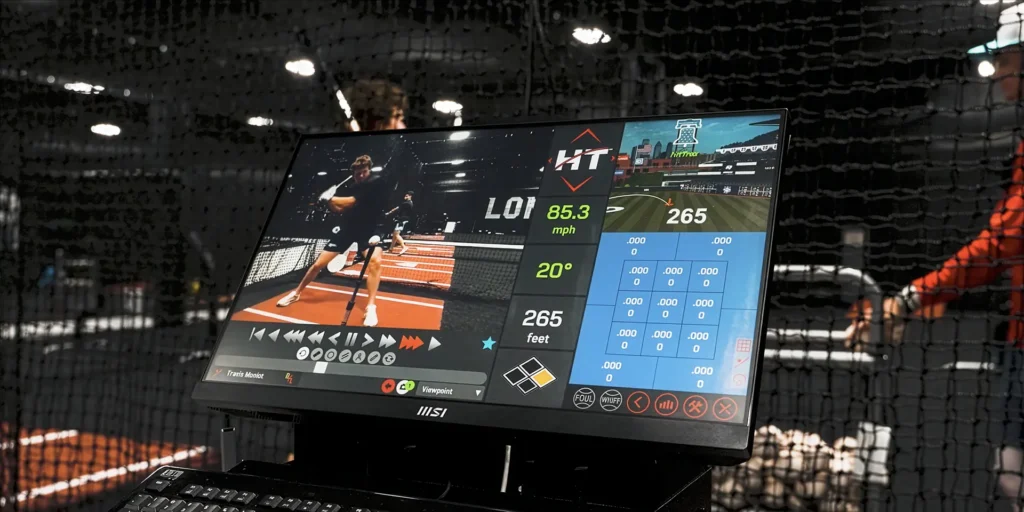
HitTrax baseball training adds another layer for hitters specifically. Exit velocity, spray chart data, and session-to-session tracking create a performance record that follows the player through their entire time at LSDA. A coach looking at that record six months in can see exactly what has improved, what hasn’t moved, and where the plan needs to shift.
That combination of Rapsodo and HitTrax data gives LSDA coaches something most Dallas facilities can’t offer: an objective, detailed picture of each player at the start and at every point along the way.
Building the Plan: What Customization Actually Looks Like
Once the assessment is complete, coaches build a development plan based on the data. That plan isn’t a template with a player’s name dropped in at the top. It’s a specific set of priorities, drills, and benchmarks built around what that individual athlete needs most right now.
For a hitter with a high exit velocity but a pull-heavy spray chart, the plan might focus on using the whole field and recognizing pitch location earlier. For a pitcher with good velocity but inconsistent arm slot, the focus shifts to release point consistency and repeatable mechanics through the full delivery. For a younger player still developing athleticism, physical conditioning and movement patterns might take priority before heavy mechanical work begins.
Movement and motor preference specialist Sam Mrstik works with players at LSDA to understand how individual athletes learn and move. That layer matters because players don’t all respond to the same coaching cues. Some players are visual learners. Others need to feel the movement before they can repeat it. Building a plan that accounts for how a player processes information makes the instruction more efficient.
Speed and agility work with Casey Mayes gets built into the plan based on what the athletic assessment shows. A player with good bat speed but slow first-step reaction needs different conditioning priorities than one who is already explosive but tires late in games. Strength and pitching specialist Chris Muller handles the physical development side, building the foundation that lets mechanics hold up over a full season.
Coaches Who Can Do Something With the Data
Data without experienced interpretation is just numbers on a screen. What makes LSDA’s approach work is the coaching staff that sits behind the technology. Cameron Dobbs played shortstop at Oklahoma State, was part of a Big 12 championship team, and has coached at the collegiate level. The rest of the staff carries similar backgrounds across hitting, pitching, and athletic development.
Those backgrounds matter because a coach who has played at a high level understands what the numbers mean in context. A spin rate of 2,400 rpm on a curveball means something different for a 13-year-old than it does for a 17-year-old projecting to college ball. A coach who has lived in those environments can put the data in the right frame and build a plan that accounts for where the player is headed, not just where they are.
That’s the standard at a baseball training academy in Dallas worth the investment. Technology tells the story. Experienced coaches write the next chapter.
Plans That Grow With the Player
One of the most important things about a customized training plan is that it isn’t static. A player who walked in six months ago with a 72 mph fastball and poor command is a different athlete today if the plan has been working. The plan has to reflect that.
At LSDA, development plans get revisited regularly. As benchmarks get hit, new ones get set. As mechanics improve, the coaching focus shifts to the next limiting factor. That ongoing adjustment is what separates a real development program from a lesson package that runs the same session week after week.
For players targeting high school varsity, a college program, or a professional career, that progression is what the next level actually requires. Scouts and college coaches aren’t just looking at where a player is. They’re projecting where that player is going. A player with a clear upward trajectory and a development history that shows consistent improvement is a more compelling recruit than one with raw tools and no documented growth.
Create an Athletic Plan that Grows With You Through Lone Star Diamond Academy
Getting to the next level in baseball takes more than hard work. It takes hard work pointed in the right direction, with a plan built around what a specific player actually needs. Generic instruction can only take a player so far. Customized development, backed by real data and coached by people who have played the game at a high level, is what moves the needle for serious athletes.
For DFW baseball families ready to stop guessing and start building, Lone Star Diamond Academy offers a baseball academy experience built around exactly that. Explore our membership options and take the first step toward a development plan built around your player.