
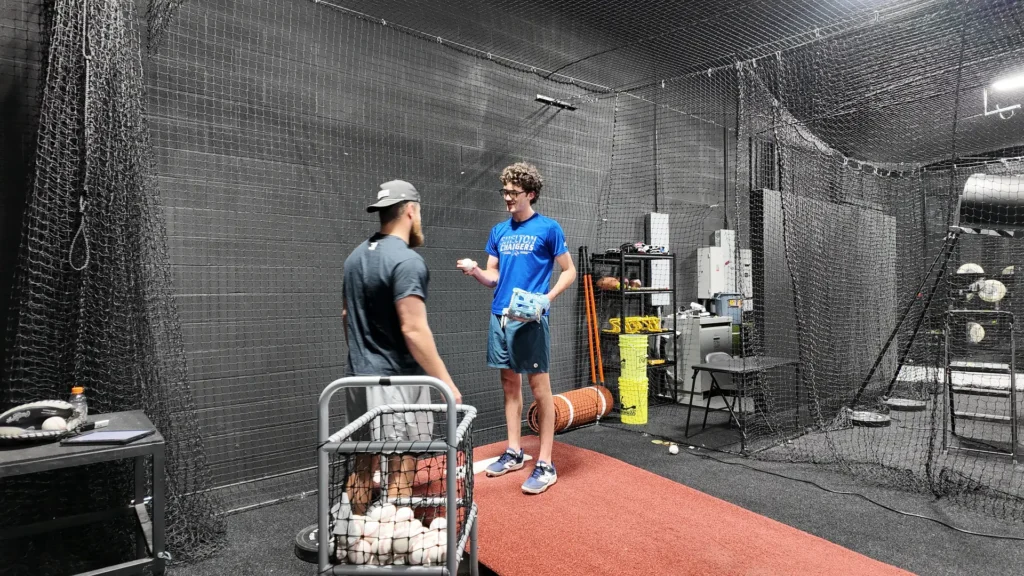
There’s no shortage of batting cages in the Dallas area. Strip mall facilities, school gyms, and backyard setups all compete for the same families. So when a parent starts searching for a baseball academy near me, the options can feel overwhelming. Price, location, and reputation all factor in. But the question worth asking isn’t just where to train. It’s where a player will actually get better.
Lone Star Diamond Academy was built around that question. From the technology on the floor to the coaches running sessions, every part of LSDA is set up to produce measurable player development. Here’s what sets it apart.
Indoor Facilities Built for Year-Round Development
Dallas weather is unpredictable. Spring storms cancel outdoor practices. Summer heat pushes training to early mornings or late evenings. Winter months create long gaps in development for players who rely on outdoor facilities.
Indoor baseball training solves that problem. At LSDA, players train in a climate-controlled environment regardless of what’s happening outside. There’s no waiting for the weather to cooperate. A player working on their swing mechanics in February shows up to their spring season with months of deliberate reps already logged. That gap between them and a player who spent the winter waiting for it to warm up is real.
Year-round access also changes how development works. Skill building isn’t seasonal at LSDA. Players can work through the off-season, the pre-season, and the in-season without interruption. That consistency compounds over time. A player who trains 12 months a year develops faster than one who trains six, assuming the instruction is quality. At LSDA, it is.
The indoor setup also means more scheduling flexibility. Sessions can happen on weekday evenings, weekend mornings, or whenever a player’s schedule allows. For DFW families managing school, other sports, and life in general, that flexibility is worth a lot.
Rapsodo Baseball Training: Data That Drives Real Improvement
Most facilities in the Dallas area offer instruction based on what a coach sees. That’s valuable, but it has a ceiling. The human eye misses things. Movement happens faster than perception can track. Rapsodo baseball training closes that gap.
Rapsodo combines high-speed cameras with radar technology to capture data on every pitch and every swing in real time. For pitchers, it measures spin rate, spin axis, velocity, release point, and pitch movement. For hitters, it tracks exit velocity, launch angle, and ball flight. These aren’t estimates. They’re precise measurements on every single rep.
What that means in practice is straightforward. A pitcher comes in throwing a curveball that doesn’t break the way he wants. Rapsodo shows exactly what his spin axis is doing and how it compares to where it needs to be. The coach has a specific target to work toward, not just a feel-based adjustment. The pitcher can see his numbers change as the session progresses. That feedback loop accelerates learning in a way that traditional coaching alone cannot.
For hitters, the story is similar. A player who is hitting weak ground balls might feel like they’re squaring the ball up. Rapsodo shows the actual exit velocity and launch angle on every swing. The data tells the truth. Coaches at LSDA use that data to build each player’s development plan, and that plan updates as the numbers change.
This is what data-driven youth baseball development in Dallas, TX, looks like. It’s not about drowning players in spreadsheets. It’s about giving coaches and players a clear, honest picture of where things stand and what to fix next.
HitTrax Baseball Training: Accountability in the Cage
Batting practice without data is a habit. Batting practice with data is a development tool. That’s the difference HitTrax baseball training makes at LSDA.
HitTrax tracks exit velocity, launch angle, estimated distance, and spray chart location on every swing. The numbers show up in real time, which changes how players approach each rep. Instead of just swinging and moving on, they see immediately whether the contact was hard or soft, and where the ball would have gone in a real game.
The stadium simulation feature adds another layer. Players can see their ball flight play out at real MLB stadiums on screen. It sounds like a small thing, but it makes practice more focused. Players who might zone out during a long cage session stay locked in when they can see exactly what each swing produces.
Session-to-session tracking is where HitTrax earns its place in long-term development. A player’s numbers from six weeks ago are right there for comparison. Progress is visible. So is stagnation. Parents can see the data too, which means development conversations are grounded in facts rather than impressions.
HitTrax also includes a biomechanics component that pairs high-speed video with ball-flight data. Coaches can study the full kinetic sequence of a swing, from the lower half load through hip rotation to barrel path. If something breaks down in that chain, the data points to exactly where. That level of analysis isn’t available at most Dallas facilities.
Coaches Who Played the Game at a High Level
Technology is only as useful as the people interpreting it. A spin rate number means nothing if a coach can’t translate it into a cue a 14-year-old can feel and apply.
LSDA’s coaching staff brings collegiate and professional playing experience to every session. Director of Baseball Cameron Dobbs played shortstop at Oklahoma State, was part of a Big 12 championship team in 2017, and has coached at the collegiate level at UT Arlington. The rest of the staff carries similar backgrounds across hitting, pitching, speed, agility, and strength.
That experience matters because these coaches have been in the situations their players are working toward. They’ve stood in against quality pitching. They’ve thrown from the mound with a count full and a runner on third. When they explain what a number on a screen means for a player’s future, they’re speaking from somewhere real.
The coaching philosophy at LSDA starts from the position that no two players are the same. Every athlete gets a development plan built around their own data, mechanics, and goals. That plan isn’t handed out at the start of the season and forgotten. It changes as the player changes.
Complete Athlete Development, Not Just Cage Work
A lot of Dallas facilities offer hitting lessons and pitching instruction. LSDA goes further. Physical development, baseball IQ, and mental performance are all built into the program.
Speed and agility training with coaches like Casey Mayes develops the athleticism that shows up in all parts of the game. Strength and conditioning work with Chris Muller builds the physical foundation that lets mechanics hold up over a long season. Movement and motor preference work with Sam Mrstik helps players understand how they learn and how to train more efficiently.
Mental performance is part of the conversation at LSDA, too. The ability to handle pressure, reset after a bad at-bat, and compete with confidence is something coaches address directly. Physical tools without mental toughness have a low ceiling. LSDA coaches understand that and build it into development from day one.
For DFW baseball families looking for a baseball training academy in Dallas that covers the full picture, LSDA is built for exactly that. This isn’t a cage rental with a coach standing nearby. It’s a structured program with a real plan behind it.
Conclusion
There are plenty of places in Dallas where a player can take swings. There are far fewer where a player can get a customized development plan, trained by coaches with high-level playing experience, backed by Rapsodo and HitTrax data, inside a year-round indoor facility built specifically for the work.
That’s what separates LSDA from most baseball academy options in the area. If you’re a DFW family searching for a baseball academy near me and want to see the difference firsthand, reach out to our team or explore our membership options. We’d love to show you what development looks like when everything is working together.